List of leadership challenges
#B329LeadershipChallenge
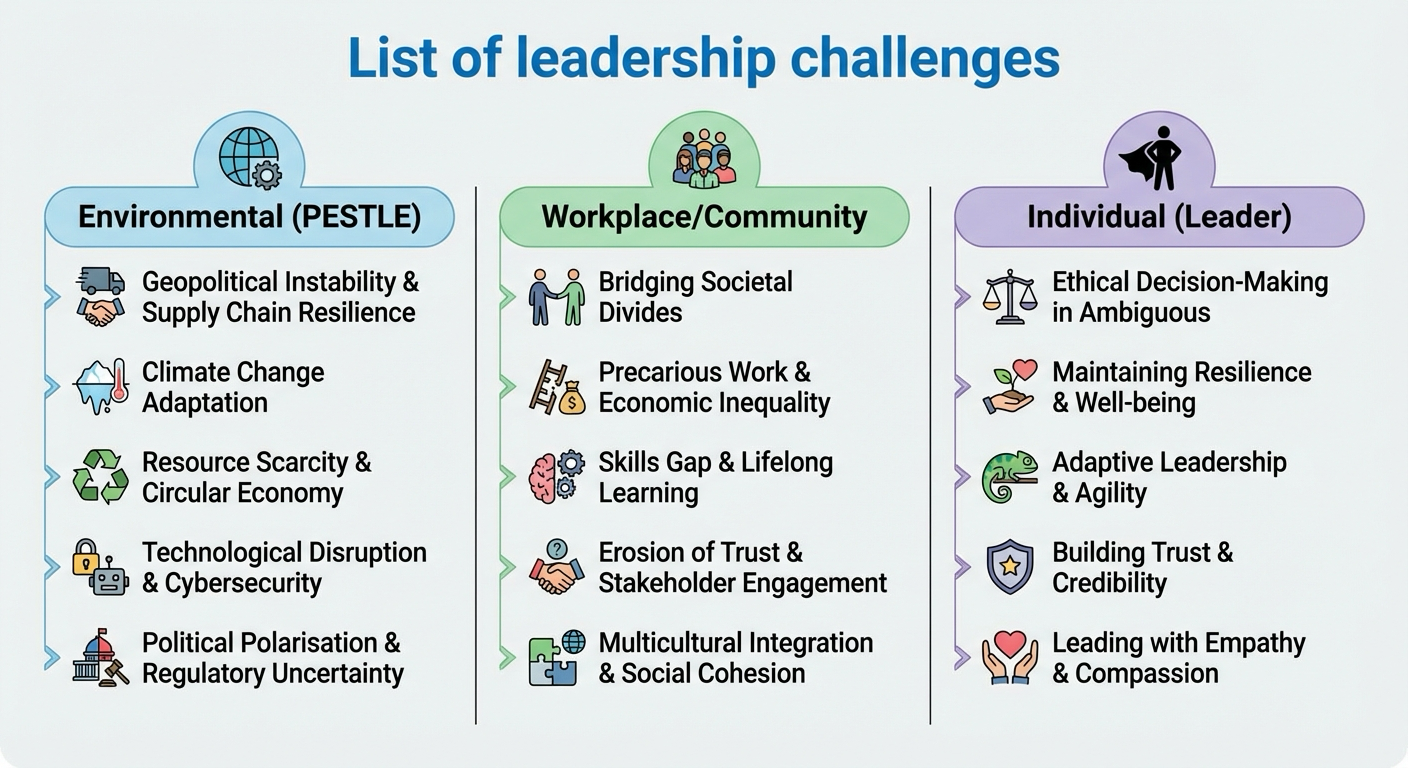
Environmental (PESTLE)
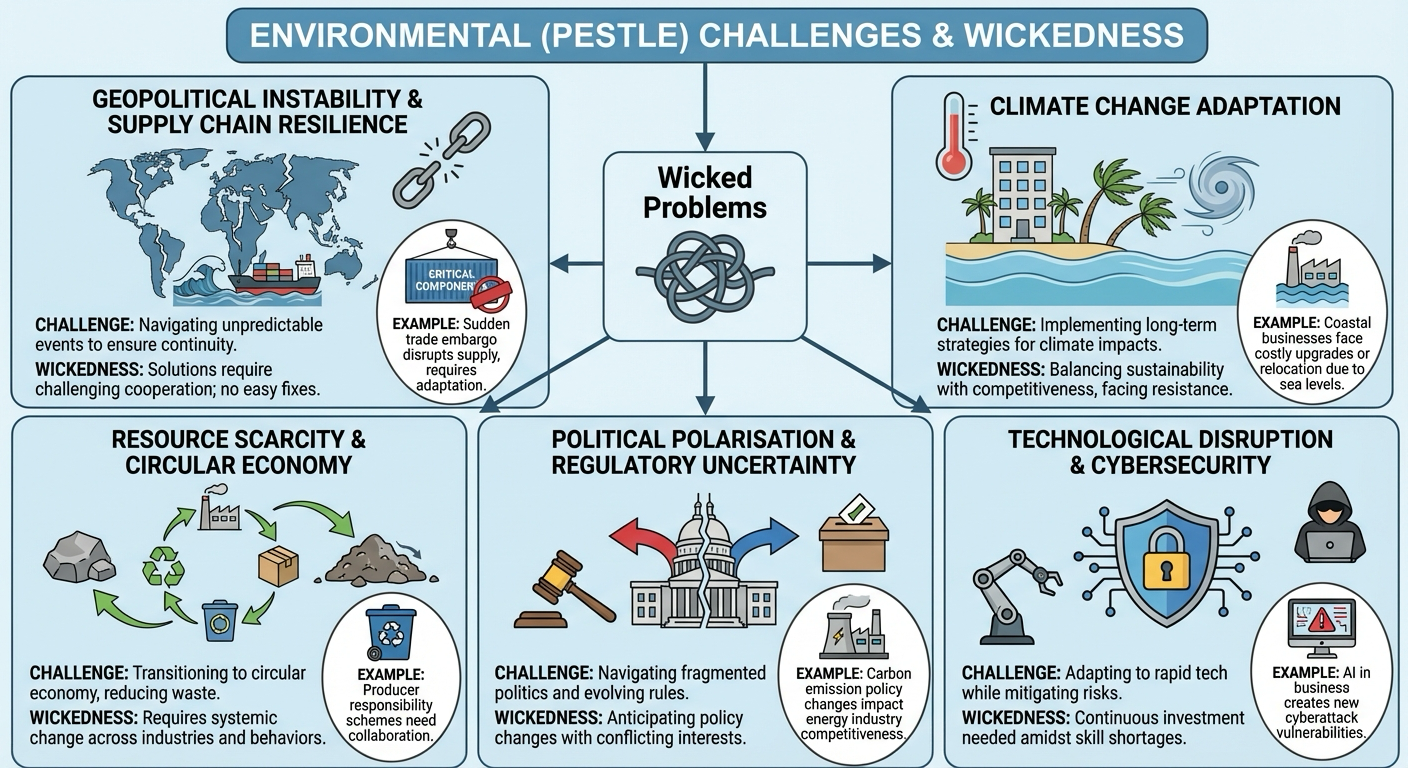
Geopolitical Instability & Supply Chain Resilience
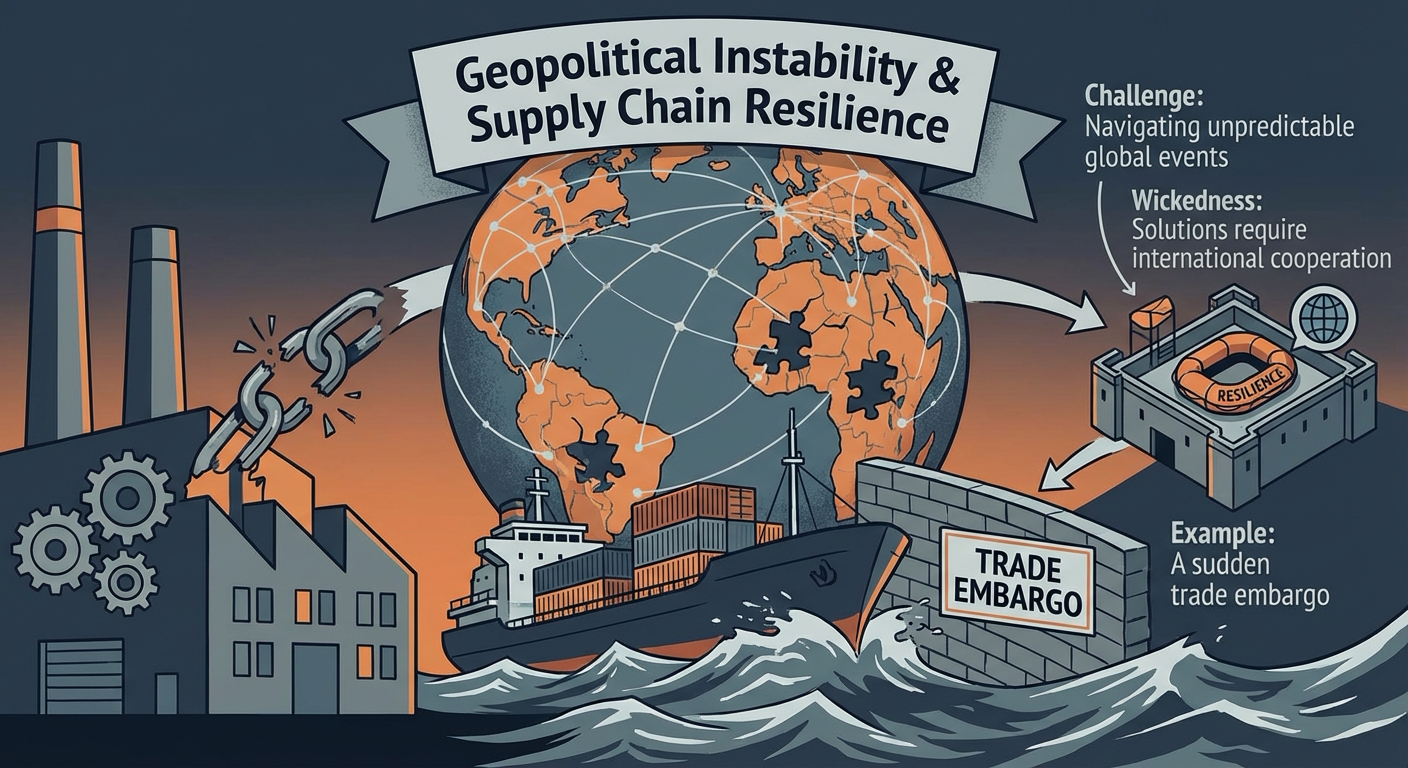
- Challenge: Navigating unpredictable global events (e.g., trade wars, resource scarcity) to ensure supply chain continuity.
- Wickedness: Solutions require international cooperation and diversification, which are often politically challenging. There are no easy fixes.
- Example: A sudden trade embargo could disrupt the supply of critical components, requiring immediate adaptation and alternative sourcing.
Climate Change Adaptation
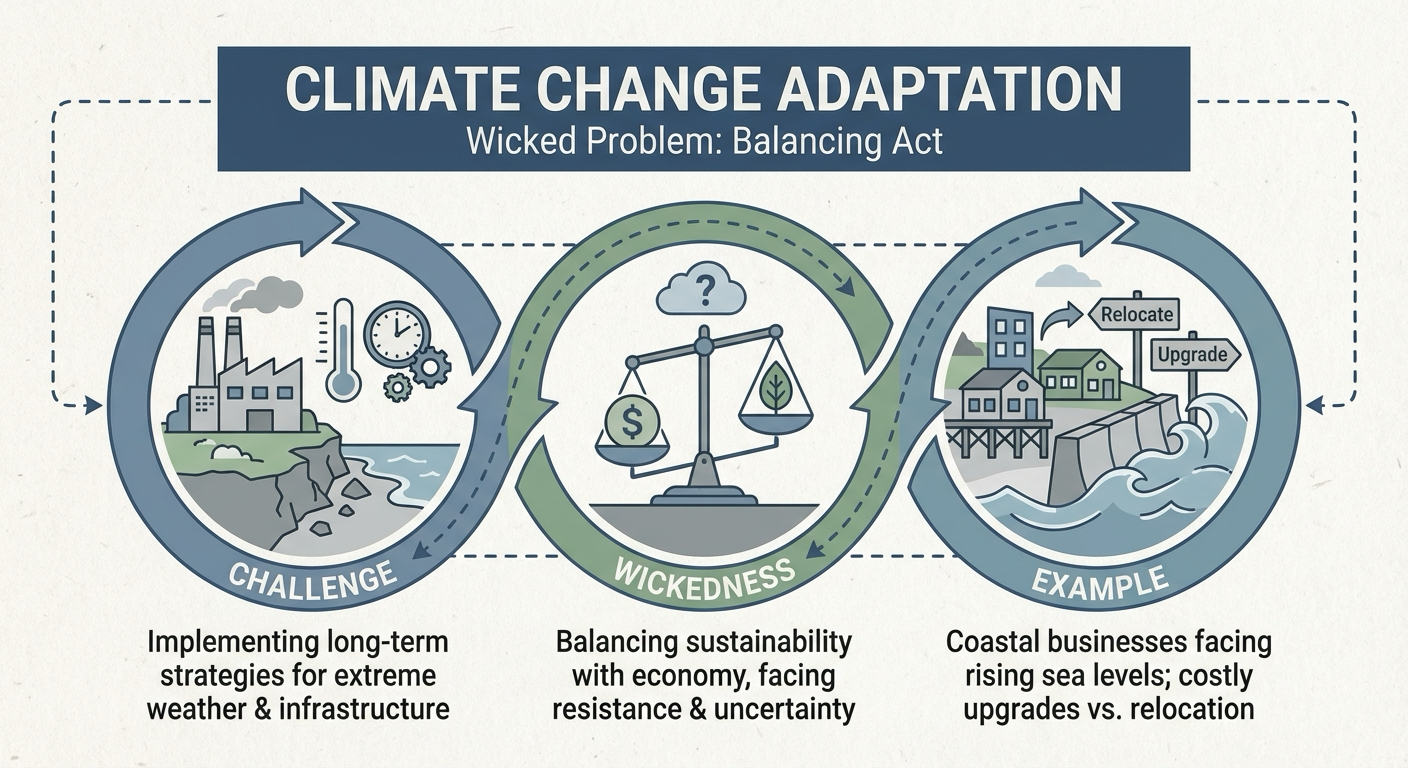
- Challenge: Implementing long-term strategies to mitigate the impact of climate change (e.g., extreme weather events) on business operations and infrastructure.
- Wickedness: Requires balancing environmental sustainability with economic competitiveness, facing resistance from vested interests and uncertainty about future climate scenarios.
- Example: Coastal businesses facing rising sea levels need to invest in costly infrastructure upgrades or relocate, impacting their profitability and the local economy.
Resource Scarcity & Circular Economy
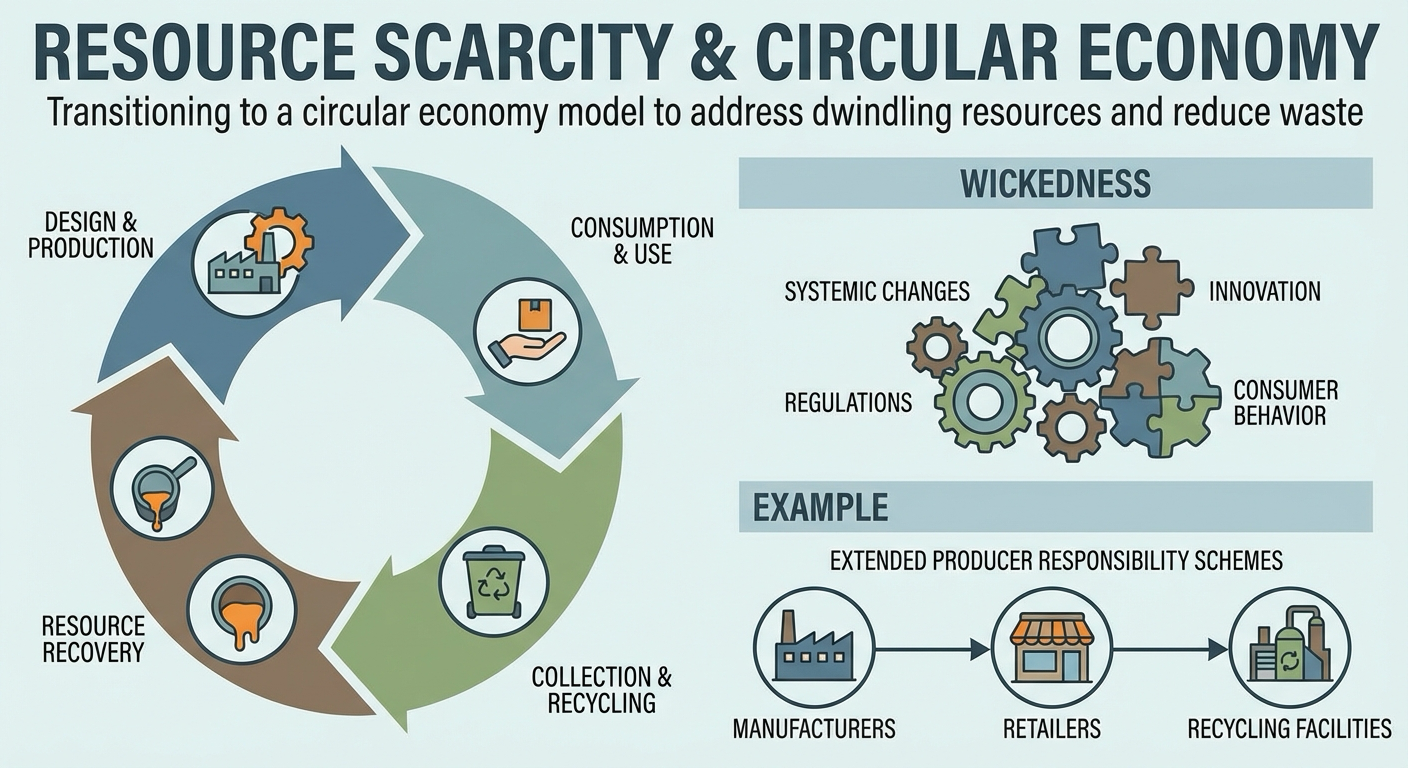
- Challenge: Transitioning to a circular economy model to address dwindling resources and reduce waste.
- Wickedness: Requires systemic changes across industries, involving complex regulations, technological innovation, and consumer behavior shifts.
- Example: Implementing extended producer responsibility schemes for electronics requires collaboration between manufacturers, retailers, and recycling facilities.
Technological Disruption & Cybersecurity
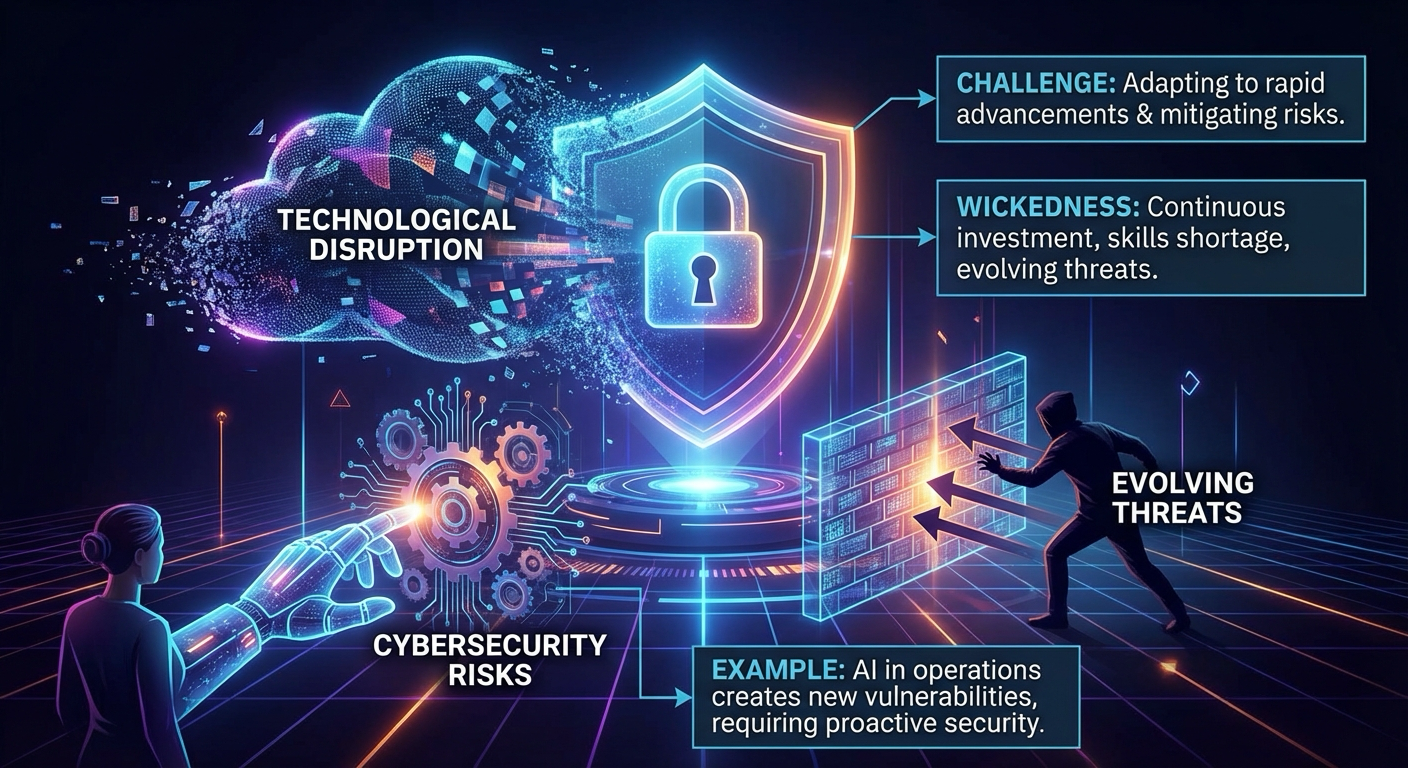
- Challenge: Adapting to rapid technological advancements (e.g., AI, automation) while mitigating cybersecurity risks.
- Wickedness: Requires continuous investment in skills development and security infrastructure, facing a shortage of qualified professionals and evolving cyber threats.
- Example: The increasing use of AI in business operations creates new vulnerabilities to cyberattacks, requiring proactive security measures and incident response plans.
Political Polarisation & Regulatory Uncertainty
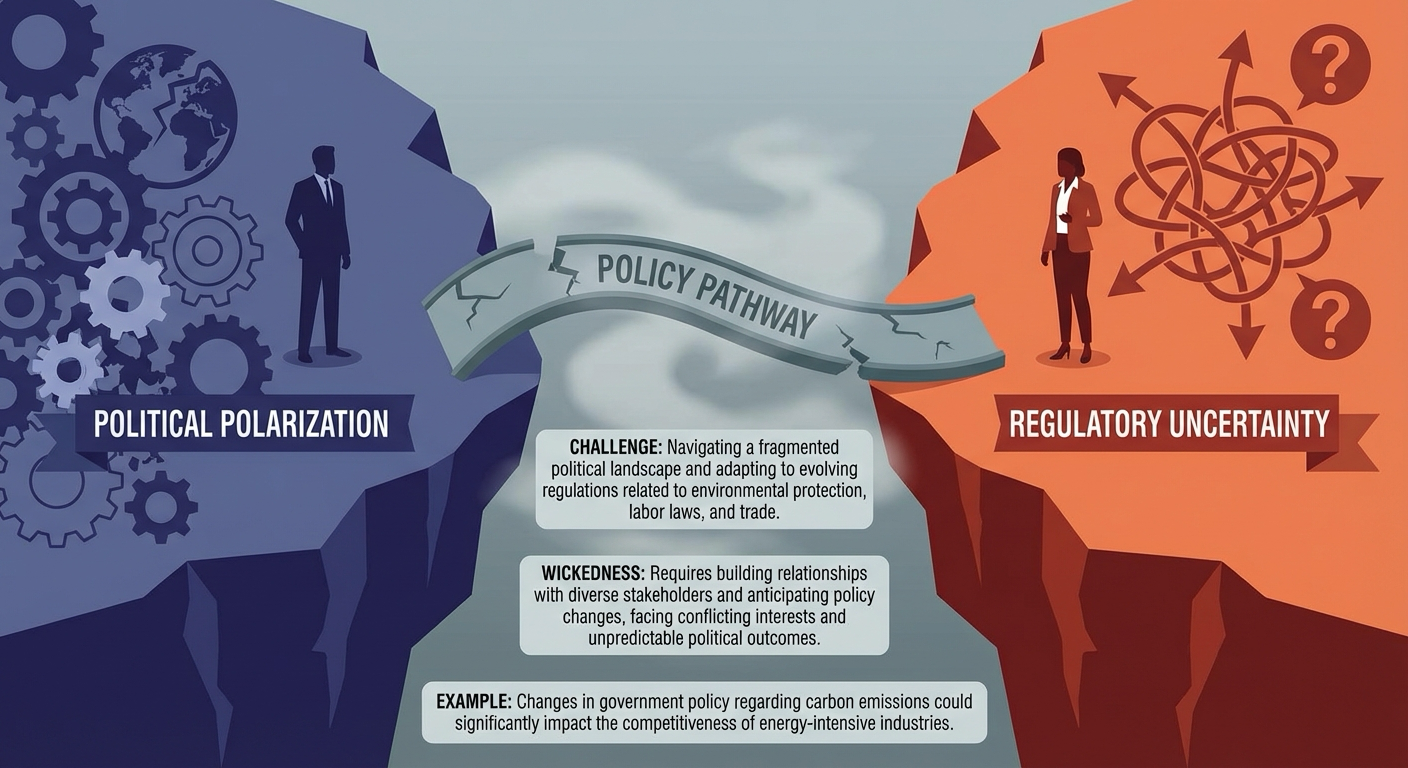
- Challenge: Navigating a fragmented political landscape and adapting to evolving regulations related to environmental protection, labor laws, and trade.
- Wickedness: Requires building relationships with diverse stakeholders and anticipating policy changes, facing conflicting interests and unpredictable political outcomes.
- Example: Changes in government policy regarding carbon emissions could significantly impact the competitiveness of energy-intensive industries.
Workplace/Community
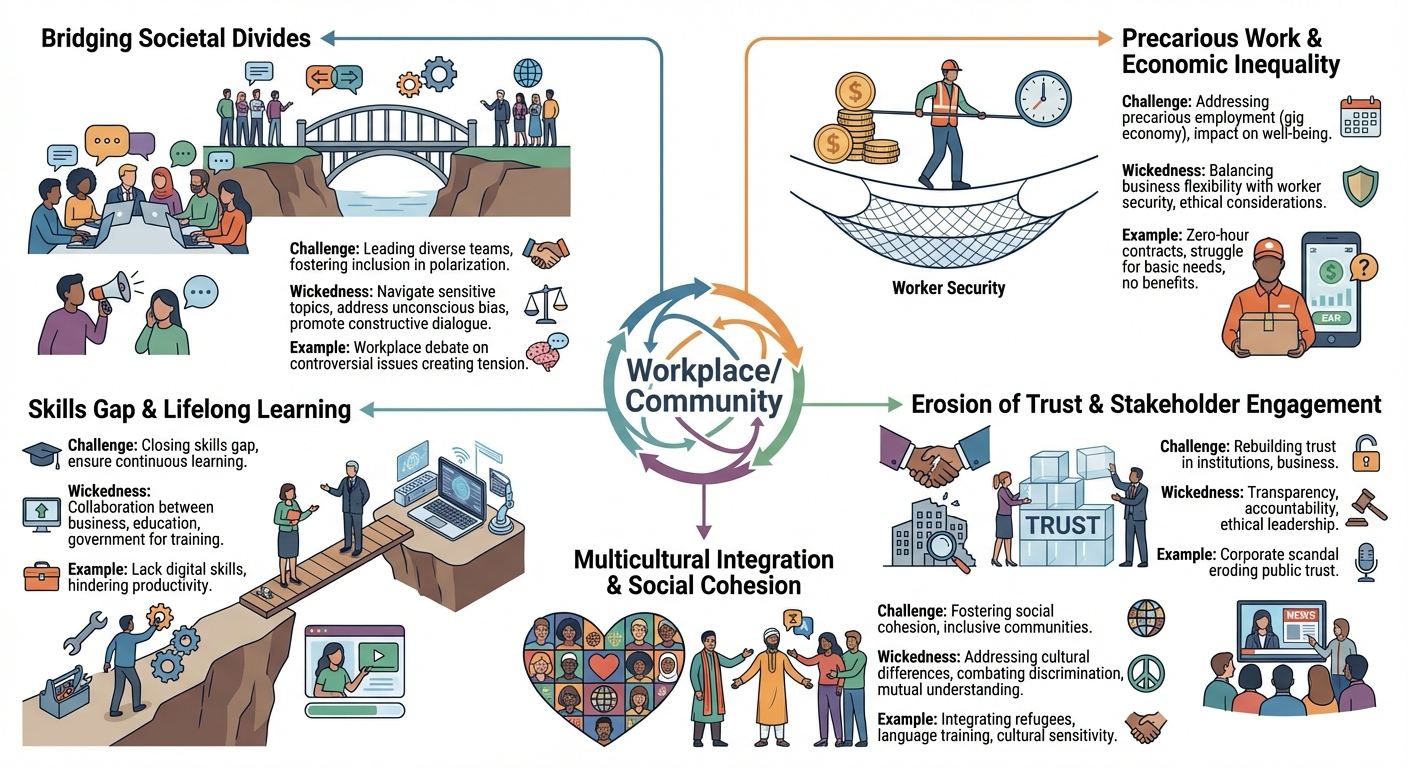
Bridging Societal Divides
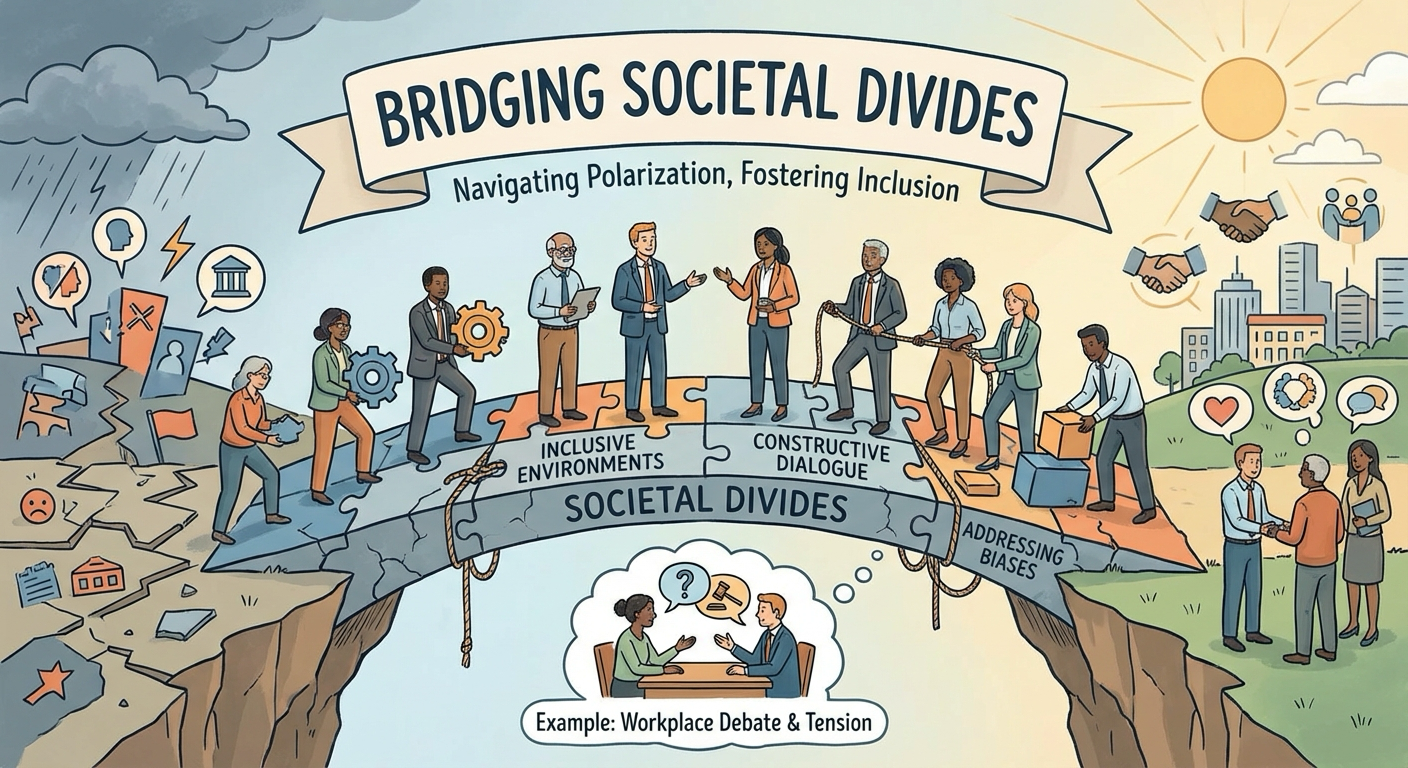
- Challenge: Leading diverse teams and fostering inclusive environments in a society increasingly polarized by political and social issues.
- Wickedness: Requires leaders to navigate sensitive topics, address unconscious biases, and promote constructive dialogue. There is no "one-size-fits-all" approach, and solutions are context-dependent.
- Example: A workplace debate on a controversial political issue could create tension and division among employees.
Precarious Work & Economic Inequality
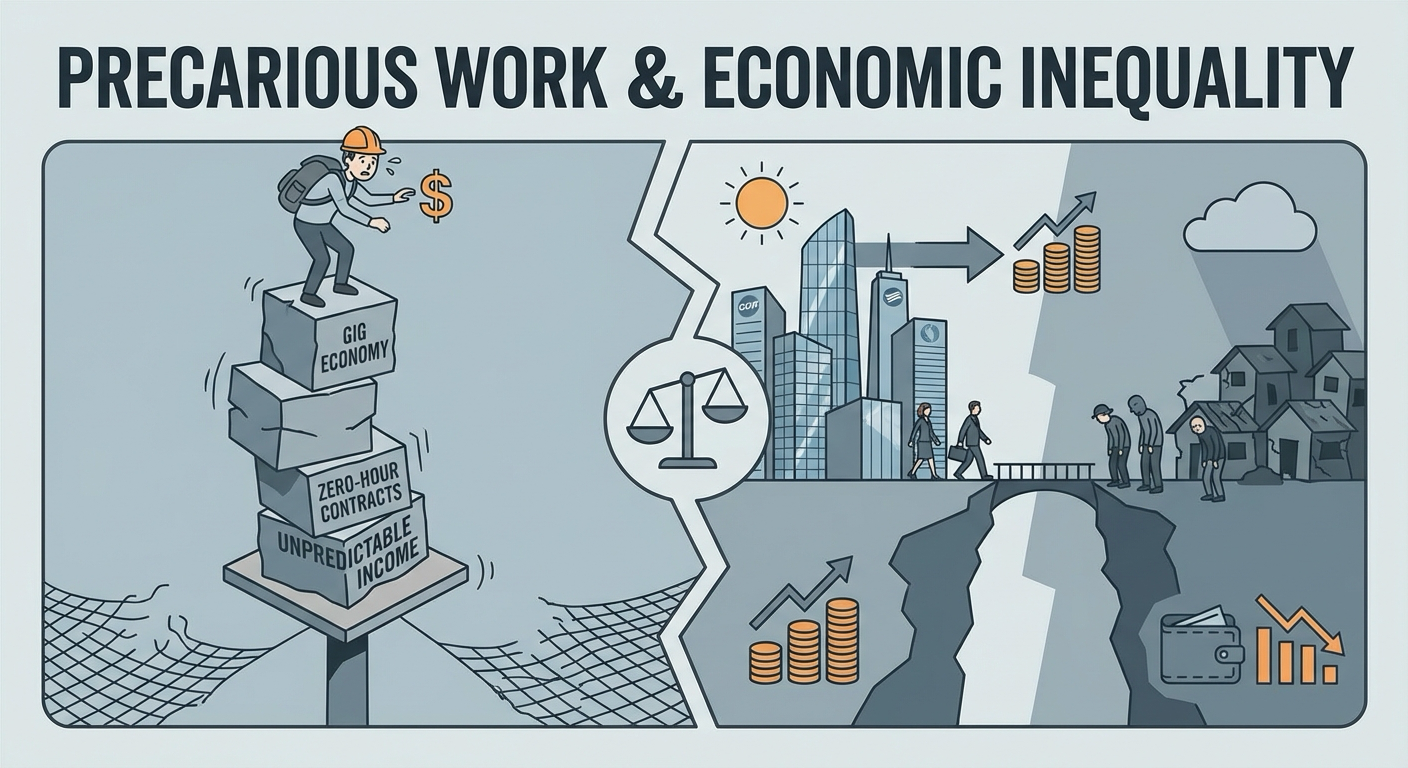
- Challenge: Addressing the rise of precarious employment (e.g., gig economy, zero-hour contracts) and its impact on worker well-being and economic inequality.
- Wickedness: Requires balancing business flexibility with worker security, facing pressure from shareholders and ethical considerations. Solutions often require policy interventions.
- Example: Employees on zero-hour contracts may struggle to make ends meet and lack access to benefits.
Skills Gap & Lifelong Learning
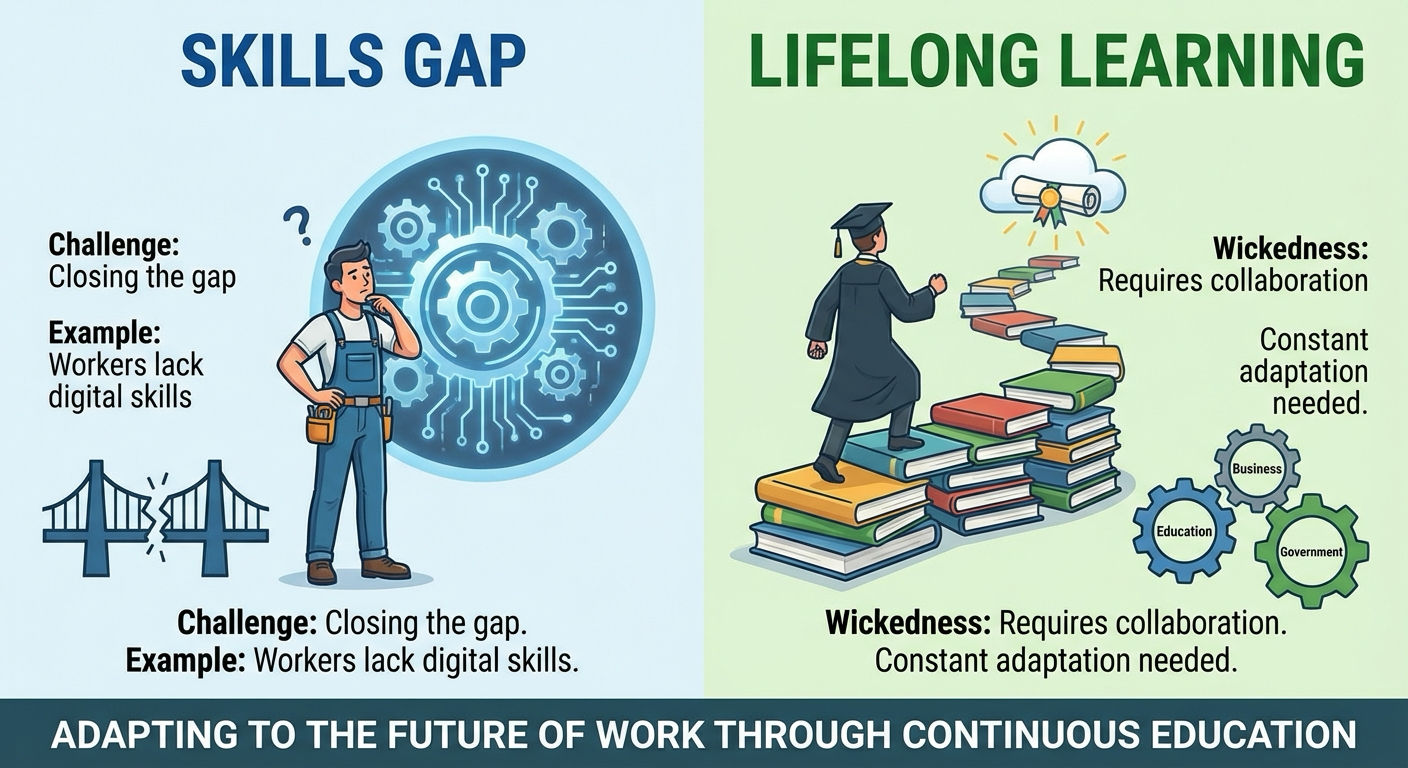
- Challenge: Closing the skills gap created by technological advancements and ensuring that workers have access to continuous learning opportunities.
- Wickedness: Requires collaboration between businesses, educational institutions, and government agencies to develop relevant training programs. There is a constant need to adapt to evolving skill requirements.
- Example: Many workers lack the digital skills needed to operate new technologies, hindering productivity and innovation.
Erosion of Trust & Stakeholder Engagement
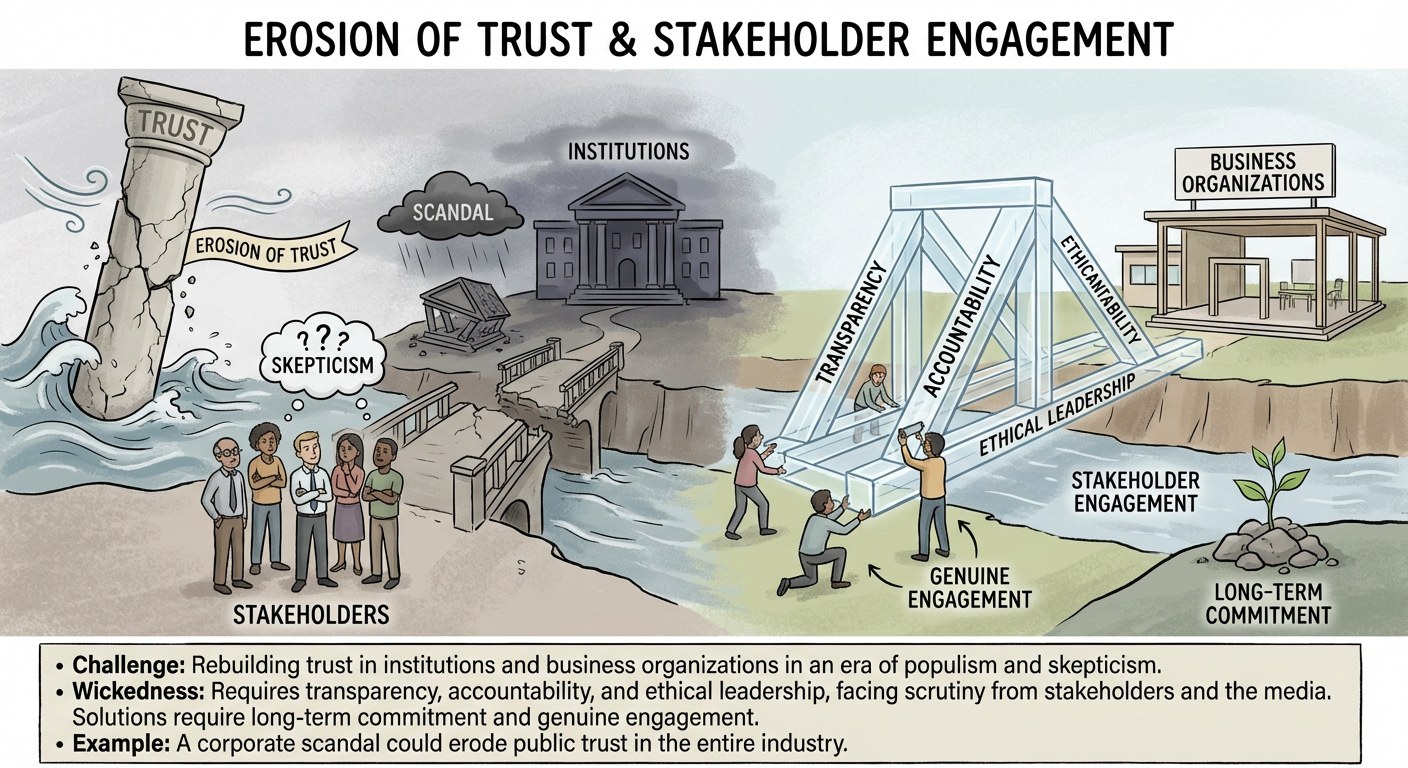
- Challenge: Rebuilding trust in institutions and business organizations in an era of populism and skepticism.
- Wickedness: Requires transparency, accountability, and ethical leadership, facing scrutiny from stakeholders and the media. Solutions require long-term commitment and genuine engagement.
- Example: A corporate scandal could erode public trust in the entire industry.
Multicultural Integration & Social Cohesion
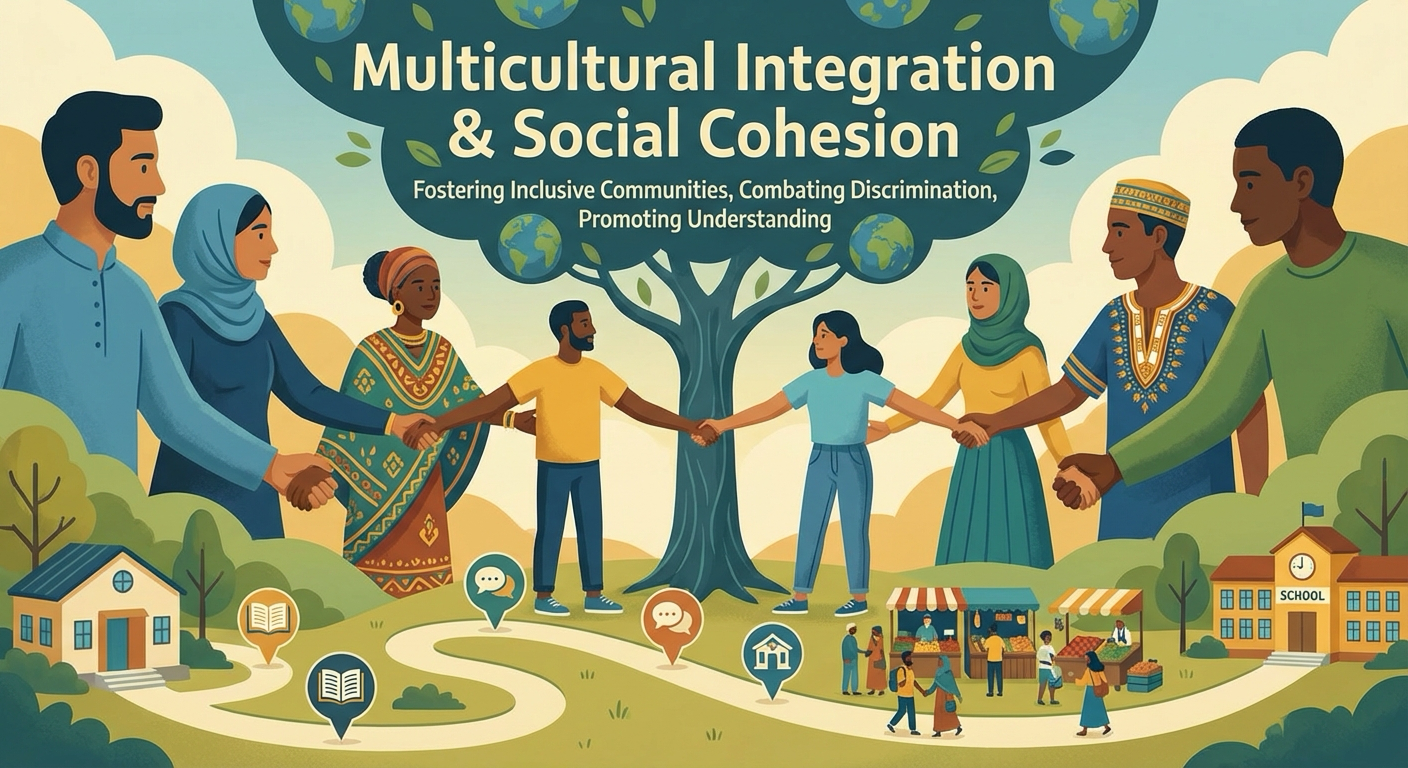
- Challenge: Fostering social cohesion and promoting inclusive communities in a multicultural society.
- Wickedness: Requires addressing cultural differences, combating discrimination, and promoting mutual understanding. Solutions are complex and require ongoing dialogue and engagement.
- Example: Integrating refugees into the workforce and community requires language training, cultural sensitivity, and employment support.
Individual (Leader)
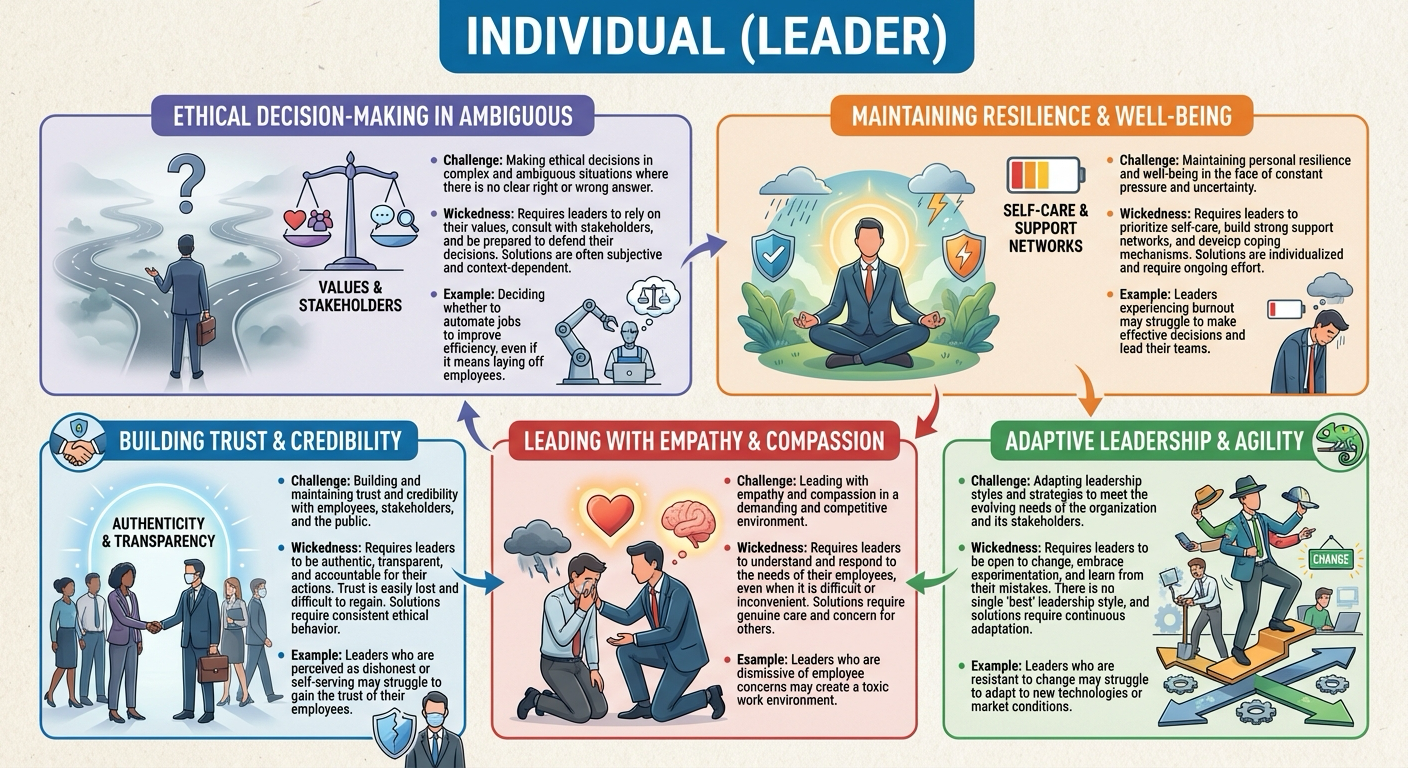
Ethical Decision-Making in Ambiguous
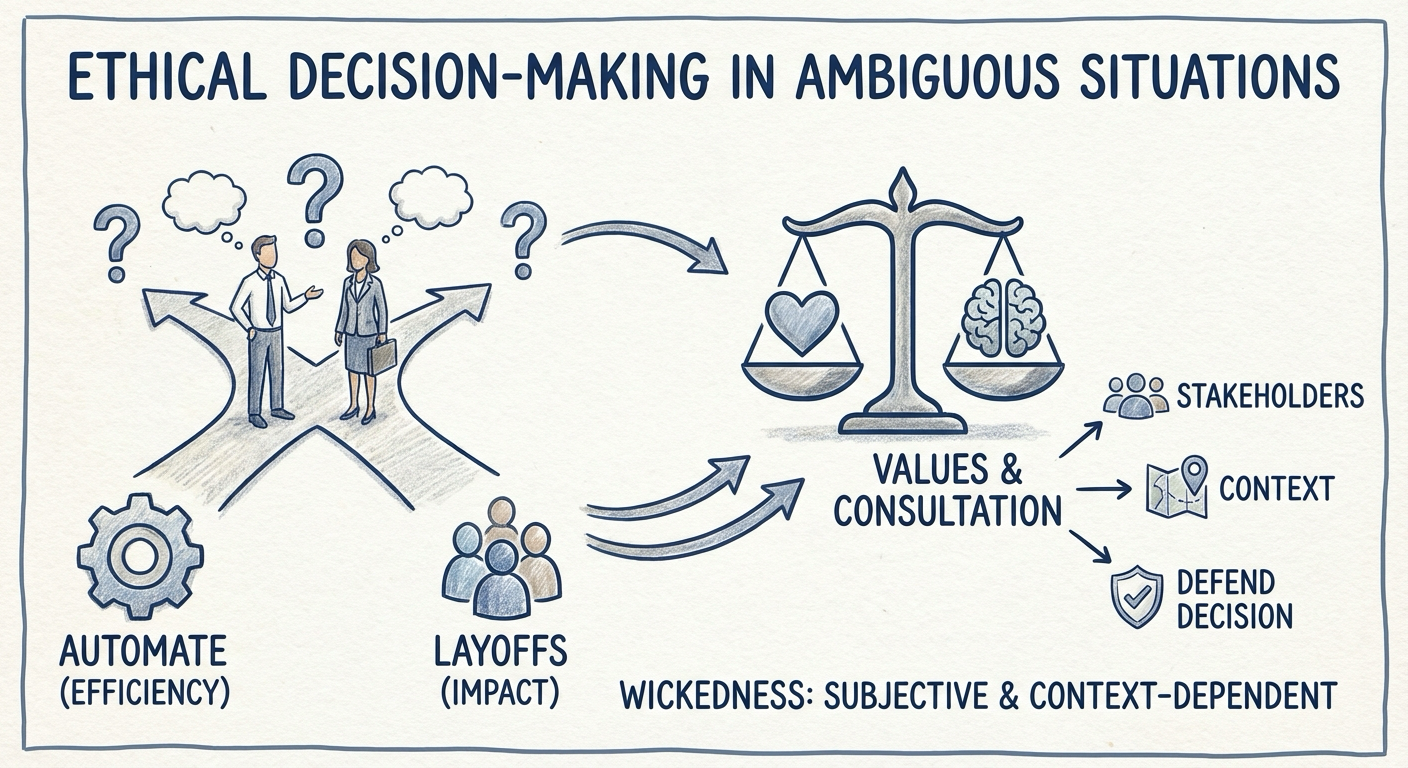
- Challenge: Making ethical decisions in complex and ambiguous situations where there is no clear right or wrong answer.
- Wickedness: Requires leaders to rely on their values, consult with stakeholders, and be prepared to defend their decisions. Solutions are often subjective and context-dependent.
- Example: Deciding whether to automate jobs to improve efficiency, even if it means laying off employees.
Maintaining Resilience & Well-being
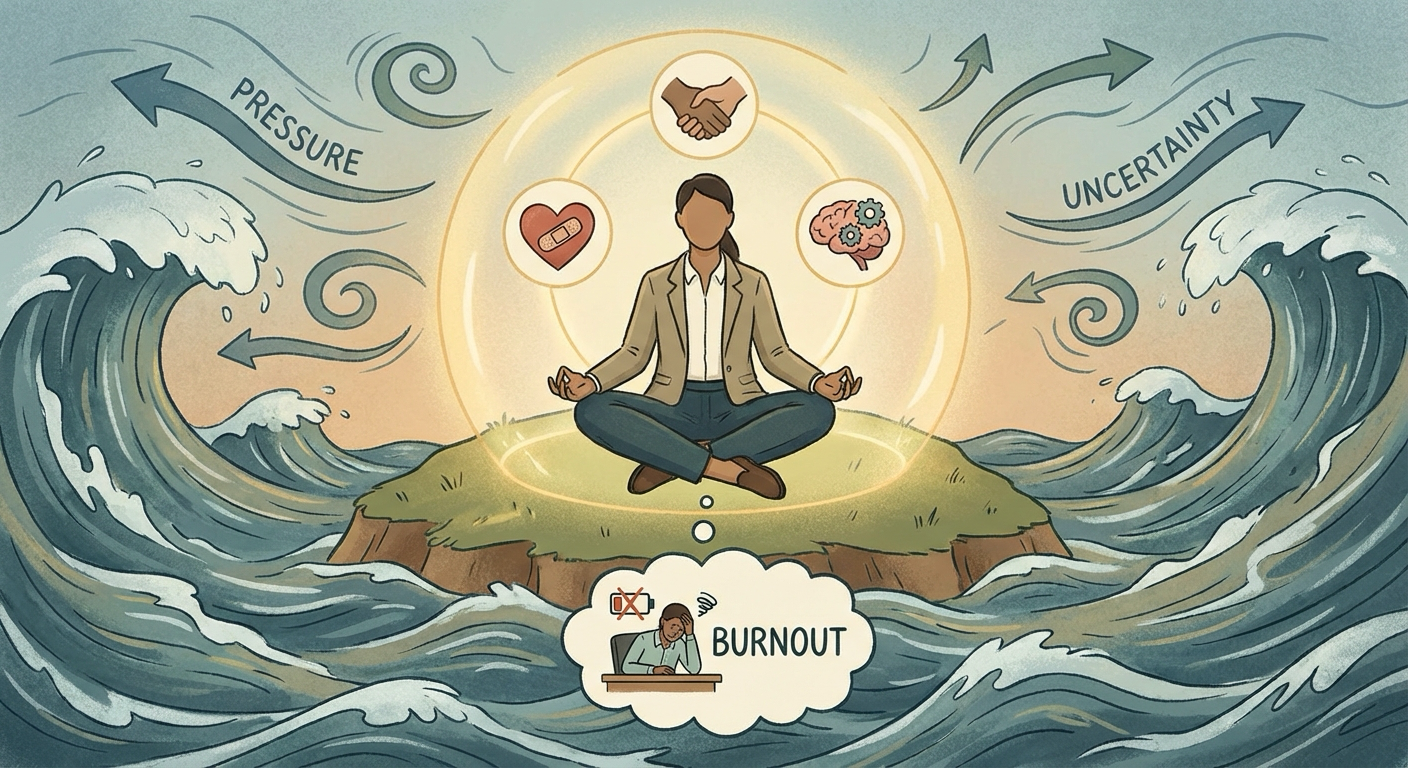
- Challenge: Maintaining personal resilience and well-being in the face of constant pressure and uncertainty.
- Wickedness: Requires leaders to prioritize self-care, build strong support networks, and develop coping mechanisms. Solutions are individualized and require ongoing effort.
- Example: Leaders experiencing burnout may struggle to make effective decisions and lead their teams.
Adaptive Leadership & Agility
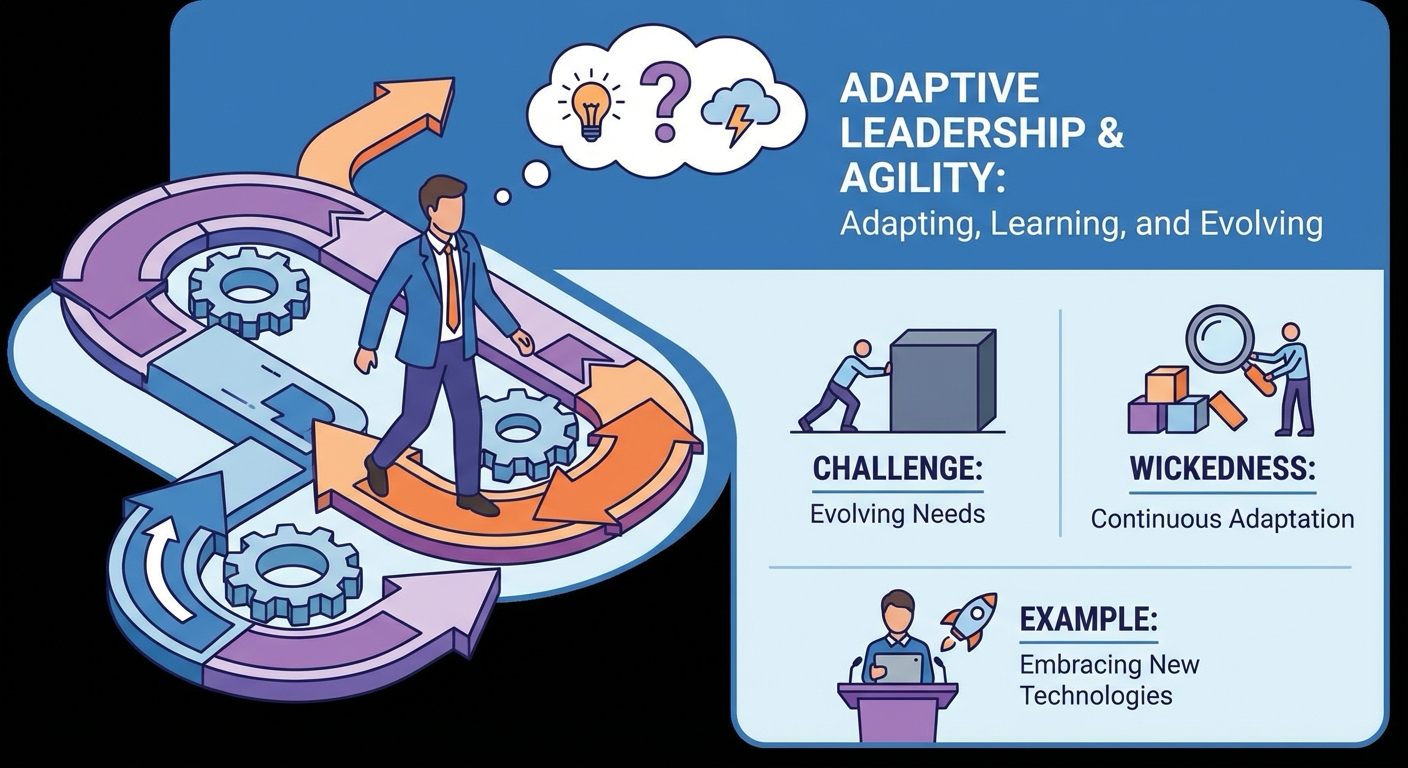
- Challenge: Adapting leadership styles and strategies to meet the evolving needs of the organization and its stakeholders.
- Wickedness: Requires leaders to be open to change, embrace experimentation, and learn from their mistakes. There is no single "best" leadership style, and solutions require continuous adaptation.
- Example: Leaders who are resistant to change may struggle to adapt to new technologies or market conditions.
Building Trust & Credibility
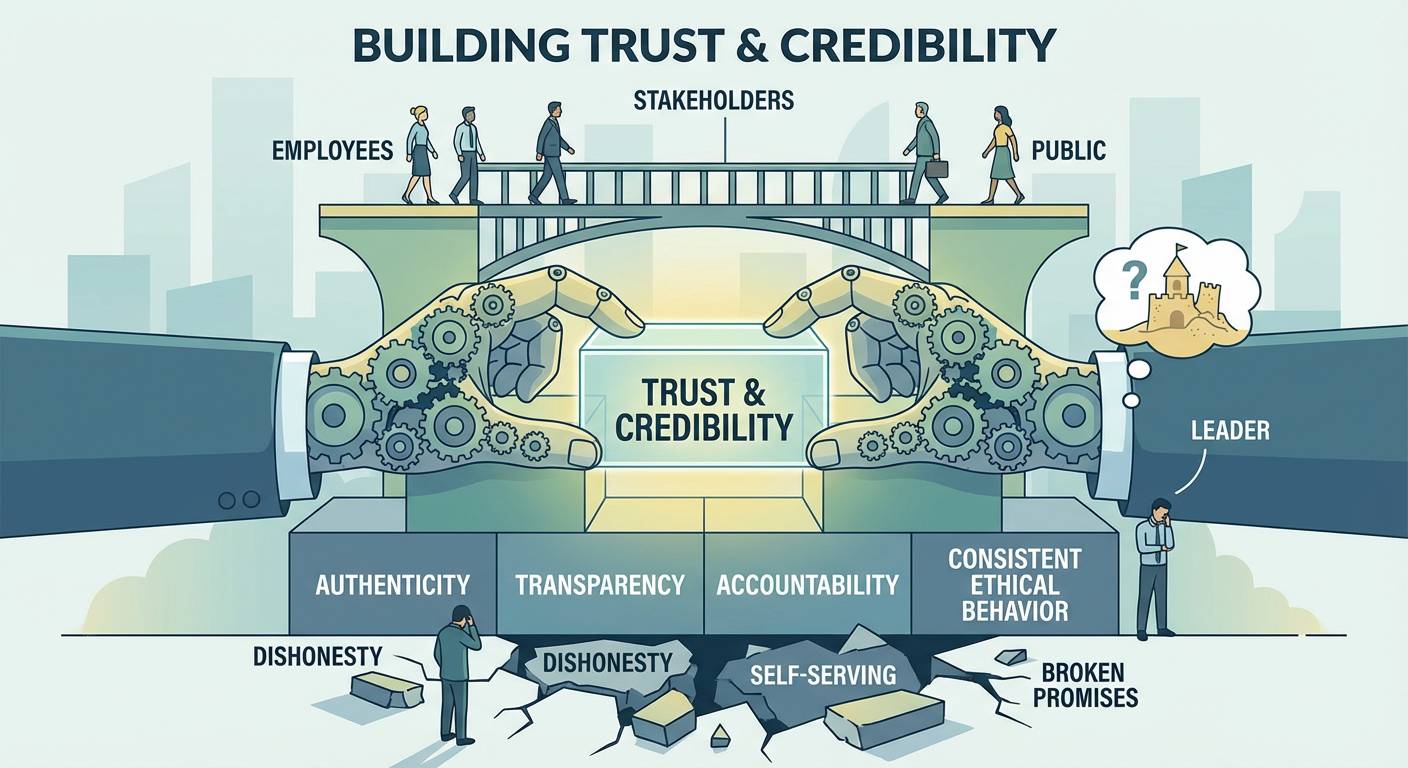
- Challenge: Building and maintaining trust and credibility with employees, stakeholders, and the public.
- Wickedness: Requires leaders to be authentic, transparent, and accountable for their actions. Trust is easily lost and difficult to regain. Solutions require consistent ethical behavior.
- Example: Leaders who are perceived as dishonest or self-serving may struggle to gain the trust of their employees.
Leading with Empathy & Compassion
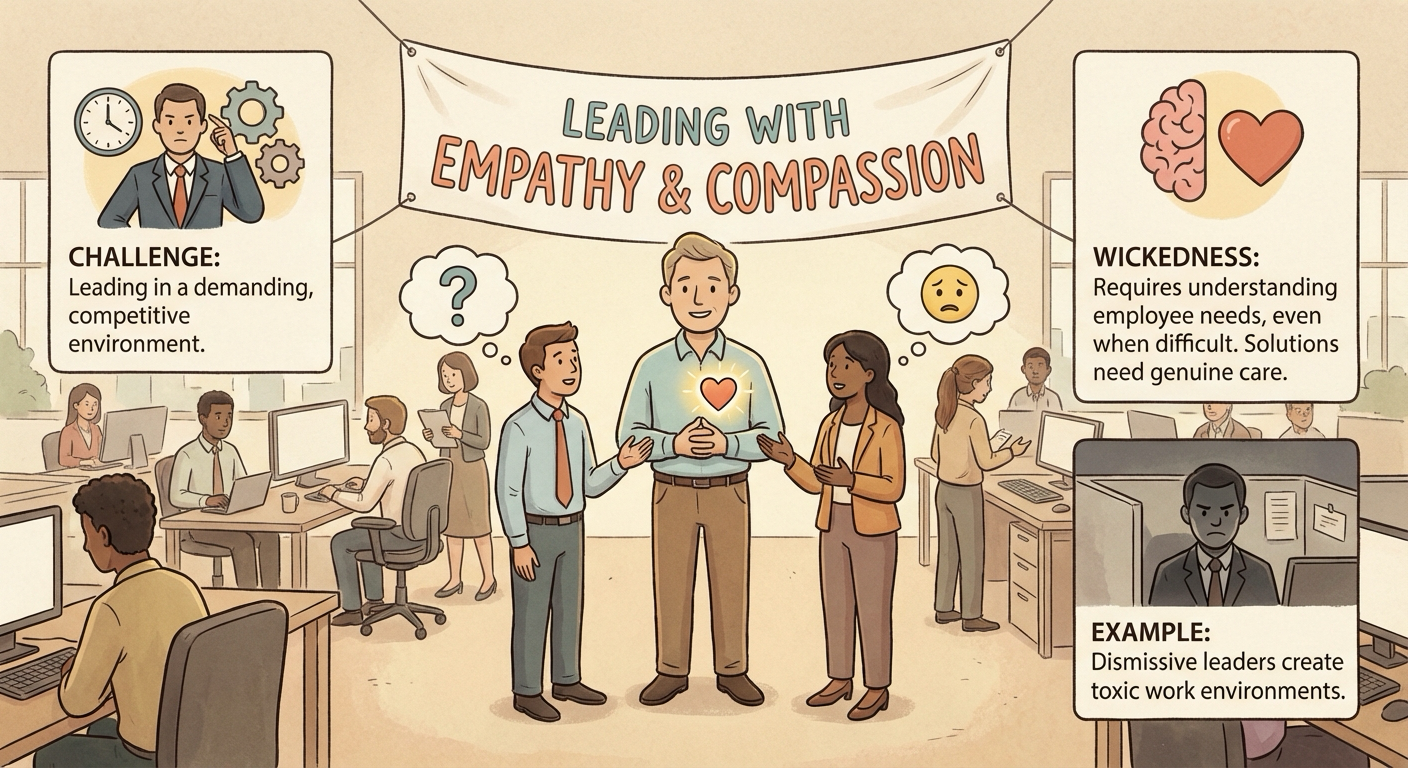
- Challenge: Leading with empathy and compassion in a demanding and competitive environment.
- Wickedness: Requires leaders to understand and respond to the needs of their employees, even when it is difficult or inconvenient. Solutions require genuine care and concern for others.
- Example: Leaders who are dismissive of employee concerns may create a toxic work environment.
Sources:
https://ssir.org/articles/entry/ecoamerica-climate-metanetwork
https://www.wicked7.org
https://ecologyandsociety.org/vol30/iss4/art53/
https://innovationwaypoints.substack.com/p/the-wicked-problem-of-program-evaluation https://lifestyle.sustainability-directory.com/area/wicked-problem-identification/